
stonework
Designing Natural Stone Steps for Sloped Landscapes
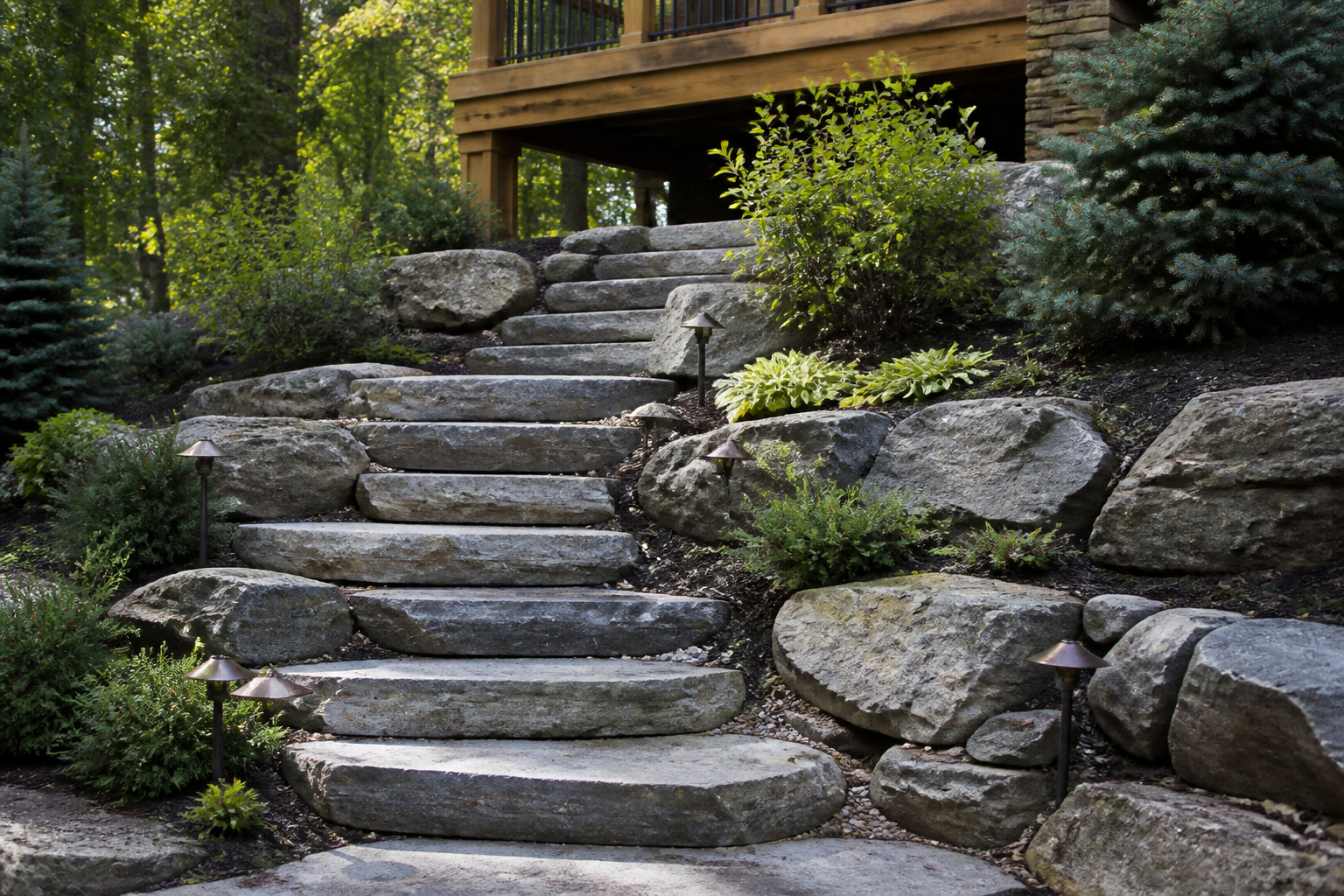
Proper natural stone steps design on a slope involves calculating a comfortable rise and run, engineering a stable base below the frost line, and integrating landings for safety and rhythm. Material choice, like weathered limestone or granite, and careful site grading are crucial for longevity and aesthetic integration with the surrounding landscape.
The Foundation of Good Design: Rise, Run, and Rhythm
Building steps on a slope is a technical exercise in geometry before it is an aesthetic one. The relationship between the vertical height of each step (the rise) and the horizontal depth (the run) determines whether a staircase feels safe and comfortable or awkward and treacherous. We begin every project by surveying the total change in elevation.
From there, we calculate the ideal dimensions. While building codes provide minimums, our goal is comfort and grace. A low, deep step can be more inviting for a garden path than a steep, short one. We find a consistent riser height between 6 and 7 inches, paired with a tread depth of 14 inches or more, often results in a relaxed and natural walking pace.
Key considerations for step geometry include:
- Total Rise: The overall vertical distance from the bottom of the slope to the top.
- Total Run: The total horizontal distance the staircase will cover.
- Consistency: Every step in a single flight must have the exact same riser height to prevent tripping hazards. Even a small variance can be noticeable and potentially create a tripping hazard.
- User Pace: The intended use of the steps—a primary entrance versus a meandering garden path—influences the final proportions.
Selecting the Right Natural Stone for Your Steps
The character of a stone staircase is defined by its material. In our service area across Caledon and The Blue Mountains, we have access to superb local stone that suits our climate and aesthetics. The choice impacts not only the look but also the construction methodology and long-term durability.
Weathered limestone and Wiarton flagstone are popular choices for their natural, layered appearance and soft colour palettes. They can be used to create built-up steps with stone risers and flagstone treads. For a more massive, grounded presence, single, large pieces of armour stone or precisely cut granite can serve as entire treads, each one weighing several hundred pounds and requiring heavy machinery to place.
| Feature | Built-Up Flagstone Steps | Solid Armour Stone Treads |
|---|---|---|
| Aesthetic | Detailed, textural, allows for intricate curves. More formal or rustic depending on the stone cut and jointing. | Massive, elemental, and grounded. Creates a strong, structural look well-suited to large-scale landscapes. |
| Construction | More labour-intensive, involving building riser walls and carefully fitting tread pieces. Mortared or dry-laid techniques. | Requires heavy machinery for placement. Each tread is a single, large slab set into the graded slope. |
| Best For | Formal entries, garden paths, and staircases with complex curves or landings. | Dramatic grade changes, hillside retention, and properties with a rugged, naturalistic character. |
Site Preparation: More Than Just Digging
The longevity of any stonework in Southern Ontario depends entirely on what lies beneath it. Our region's freeze-thaw cycles will relentlessly push and shift any structure built on an unstable base. For stone steps, proper site preparation is a non-negotiable sequence.
- Excavation: We begin by excavating the entire footprint of the staircase area, not just individual steps. This cut extends deep enough to remove all topsoil and create a stable, sloped sub-grade.
- Base Installation: The entire excavated slope is lined with a geotextile fabric to separate the native soil from our new base. This prevents silty soil from migrating up and compromising drainage.
- Compaction: We then build up a thick, stable foundation of compacted granular A gravel. This base is brought up in lifts, with each layer being systematically compacted to ensure a solid, interlocking structure that will not settle.
- Drainage: Proper drainage is engineered into the base to ensure water moves away from and out from under the steps, preventing hydrostatic pressure and frost heave.
The Art of the Landing: Pauses in the Ascent
A long, uninterrupted flight of stairs can be physically daunting and visually monotonous. Landings are the solution. They are essential safety features that provide a place to rest, but they are also a powerful design tool. A well-placed landing can change the direction of a staircase, create a destination point with a bench, or frame a specific view of the property.
Good steps feel like an extension of the hill, not an imposition on it.
For any significant change in elevation, we incorporate generous landings into the design. These are not mere afterthoughts; they are planned as part of the overall rhythm of the staircase. A landing can be a simple, square flagstone patio or a more complex space that transitions to another garden path. This is a key part of how we approach a holistic landscape design.
Integrating Steps with the Broader Landscape
Stone steps should never feel isolated from their surroundings. The final stage of a successful installation is integrating them into the fabric of the garden. This involves careful grading to blend the edges of the staircase into the adjacent slope, preventing erosion and creating a seamless visual transition.
Planting plays a crucial role. We select species that thrive on slopes and soften the hard edges of the stone.
- Low-growing, spreading groundcovers like Creeping Thyme or Japanese Forest Grass can be planted in pockets between stones.
- Drought-tolerant perennials like Catmint and ornamental grasses like Switchgrass can anchor the sides of the staircase.
- For larger landings, a specimen tree like a Serviceberry can provide seasonal interest and a vertical accent.
Landscape lighting is another key consideration, planned from the start. Discreet lights can be installed under the lip of a tread or on the side of a riser to wash the step with a soft glow, ensuring safe navigation after dark without creating glare. Check out our portfolio to see examples of how these elements come together.
Building a beautiful, enduring stone staircase is a significant undertaking. It requires a deep understanding of site engineering, materials, and design principles. If you are planning a project on a sloped property, we invite you to start a project with our team.
Frequently asked
Questions, answered
- How deep do you have to dig for outdoor stone steps?
- For long-term stability in Ontario, we excavate all topsoil and create a deep, compacted granular base (at least 12-18 inches) that extends below the steps to manage frost heave effectively.
- What is the best stone for outdoor steps in Ontario?
- We favour durable, locally sourced materials like Wiarton/Eramosa limestone and granite for their ability to withstand our freeze-thaw cycles. The choice depends on the property's aesthetic and the structural needs of the staircase.
- How long does it take to build a natural stone staircase?
- The timeline varies widely with the scale, site access, and complexity. A simple set of steps may take a week, while an extensive staircase with landings on a steep Hockley Valley slope can be a multi-week component of a larger project.
- Do I need a permit to build landscape steps?
- Often, yes. If the steps are part of a retaining wall system or significantly alter site grading, a permit may be required by your local municipality, such as the Town of Caledon or Mono. We manage this process as part of our design-build service.
- Can you add lighting to natural stone steps?
- Absolutely. We integrate low-voltage LED lighting into our step designs from the beginning, often tucking fixtures under treads or into riser faces for safe, subtle illumination. This requires planning conduit and wiring during the base preparation phase.
Related on the site
Start a conversation
Planning a project in the Headwaters region?
We design and build across Hockley Valley, Caledon, Mulmur, Mono, King, and The Blue Mountains. Tell us about your property and we'll take it from there.
Book a discovery call →