
design
Landscape Lighting that Suits a Country Property: Layers, Fixtures, and Restraint
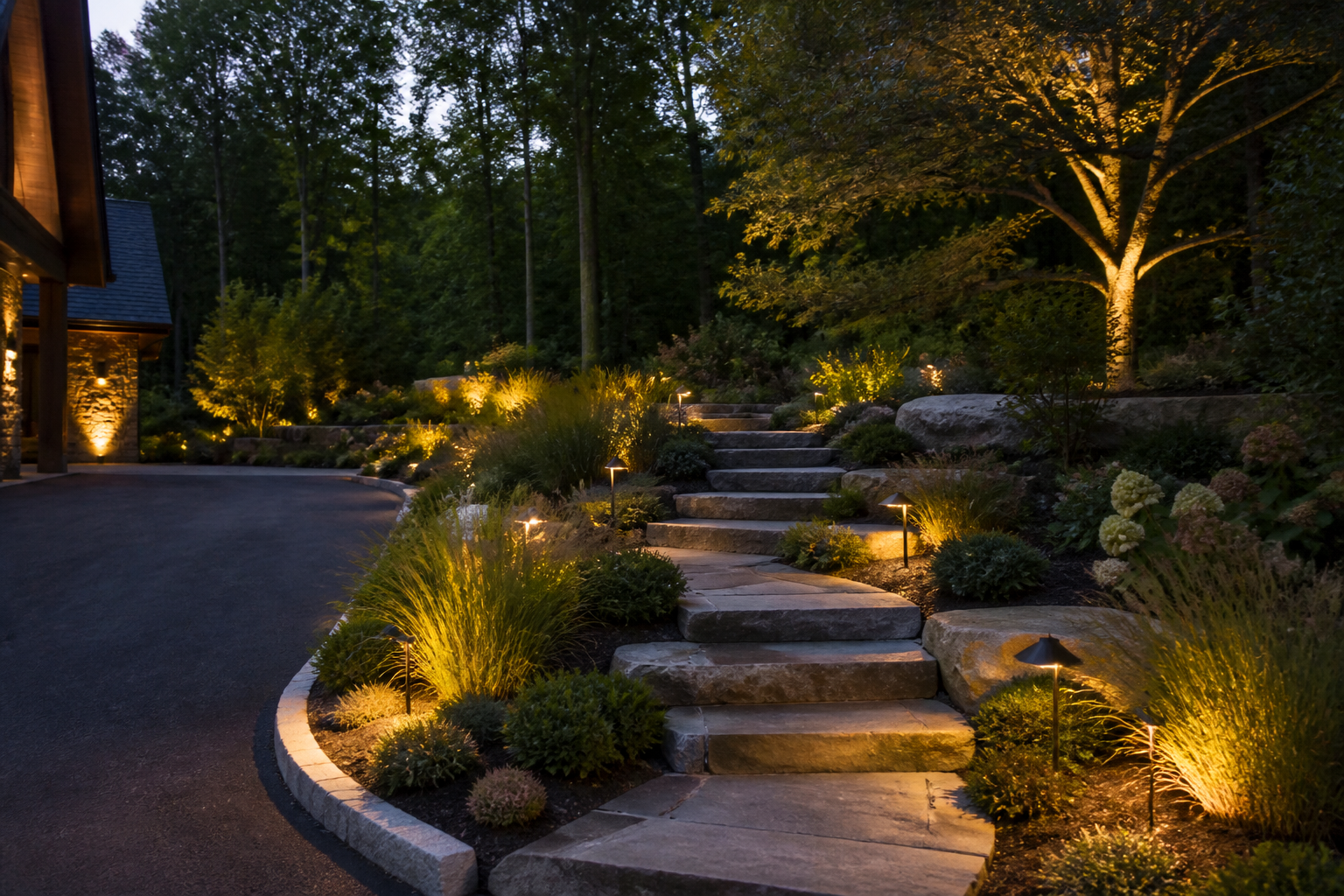
Effective landscape lighting design for a country property is about strategic revelation, not broad-spectrum floodlighting. It uses carefully placed, high-quality fixtures to create layers of light that guide movement, highlight architectural and natural forms, and establish ambiance—all while preserving the essential character and darkness of a rural setting.
Beyond Security: The Philosophy of Estate Lighting
On an estate property in Caledon or Mulmur, the goal of outdoor lighting is not to eliminate darkness but to curate it. While security is a component, the primary function is to extend the usability and enjoyment of the landscape after sunset. This requires a shift in thinking from simply illuminating an area to painting with light.
This approach aligns with dark-sky principles, which aim to reduce light pollution. By using focused, shielded, and downward-facing fixtures, we can create a safe and beautiful environment without contributing to skyglow. This preserves views of the stars and respects the nocturnal patterns of local wildlife—a key part of responsible stewardship in our service area.
Key principles for estate lighting include:
- Subtlety over Spectacle: The most effective lighting is often that which you don't immediately notice. The focus should be on the illuminated object—the texture of a stone wall, the canopy of a tree—not the light source itself.
- Warmth and Colour: We specify fixtures with a warm colour temperature (typically 2700K to 3000K). This mimics incandescent light or candlelight, creating a welcoming atmosphere that feels natural and avoids the sterile, blue-white glare of higher-temperature LEDs.
- Cohesion with Architecture: The style of the fixtures should complement the home's architecture and the landscape's material palette. A modern home may call for sleek, minimalist fixtures, while a stone farmhouse benefits from classic, weathered brass forms.
The Three Layers of Landscape Lighting
A sophisticated lighting plan is built from three distinct but overlapping layers. Each serves a different purpose, and together they create depth, interest, and functionality. Our design process considers how these layers interact across the entire property.
Task Lighting: This is the most functional layer, focused on safety and navigation. It includes path lighting along walkways, step lights integrated into stone steps, and downlighting over outdoor kitchen or dining areas. The goal is to provide enough light to see clearly and move safely, using pools of light rather than a continuous, runway-like effect.
Accent Lighting: This layer creates focal points and highlights the property's best features. It's where the artistry of lighting design truly comes into play. Techniques include uplighting specimen trees, grazing textured stone walls to reveal their depth, and illuminating sculptures or water features. Accent lighting draws the eye and gives the landscape a dramatic, three-dimensional quality at night.
Ambient Lighting: This is the soft, foundational glow that fills the space between task and accent lights. It reduces harsh shadows and creates a sense of comfort and enclosure. Ambient light is often indirect, sourced from downlights placed high in mature trees (moonlighting), light reflecting off a building façade, or the gentle illumination from within a pergola or pavilion.
Selecting Fixtures: Materiality, Durability, and Placement
The quality of the fixtures is as important as the design itself. In our climate, with its freeze-thaw cycles and seasonal moisture, durability is non-negotiable. We avoid plastic and low-grade aluminum fixtures, which degrade quickly under UV exposure and become brittle in the cold.
| Fixture Type | Common Use Case | Design Consideration |
|---|---|---|
| Path Lights | Walkways, garden edges, patio perimeters | Stagger placement on either side of a path to avoid a 'runway' look. Ensure the shield directs light down onto the path, not into eyes. |
| Uplights / Well Lights | Trees, architectural columns, wall grazing | Beam spread is critical. A narrow beam (15°) is for tall, columnar trees like an Oak; a wider beam (60°) for a broad canopy like a Maple. |
| Downlights / 'Moonlights' | Mounted high in trees to mimic moonlight, over dining areas | Placement is key to creating a natural, dappled effect on the ground below. Requires professional installation for secure mounting and wiring. |
| Hardscape Lights | Under coping on retaining walls, stairs, and benches | Must be integrated during construction. Provides excellent, glare-free task lighting that defines structure and elevation changes. |
Our material specifications prioritize longevity:
- Solid Brass & Copper: These are lifetime materials. They develop a natural patina over time that blends beautifully into the landscape. They are impervious to rust and corrosion.
- Powder-Coated Aluminum: For a more contemporary look, high-grade, marine-rated powder-coated aluminum offers excellent durability and colour stability.
- Integrated LEDs: We specify fixtures with integrated LED light sources. Unlike systems with replaceable bulbs, these are fully sealed units, which prevents moisture intrusion—the number one cause of failure in landscape lighting.
Good lighting design is felt more than it is seen, guiding you through a space while highlighting the beauty that is already there.
Illuminating Natural Features: Trees, Stonework, and Water
Applying light to natural elements requires a delicate touch. The technique varies depending on the subject's form, texture, and seasonal character.
For trees, the approach depends on its species and structure. A columnar tree like a Swedish Aspen is best lit with a narrow-beam uplight placed close to the trunk. A broad, deciduous tree like a Red Oak benefits from two or more wider-beam lights placed further from the trunk to illuminate the underside of its canopy.
For stonework, the technique of grazing is highly effective. By placing a light source close to a wall and directing the beam parallel to the surface, you create dramatic shadows that emphasize the texture and craft of the stone. This is particularly effective for the weathered limestone and granite fieldstone common in our region.
Lighting a pond or waterfall adds another dimension entirely. Submersible lights can create a glow from within the water, highlighting the movement and depth of a waterfall. For ponds, lighting is best focused on perimeter plantings and key features, allowing the water's surface to reflect the night sky.
Practicalities: Controls, Zoning, and Professional Integration
A well-designed system is also simple to operate. Modern control systems allow for a high degree of customization.
We typically design systems with multiple zones. This allows you to control different areas of the property independently. For example, the path lighting might be on a simple timer, while the accent lighting for entertaining areas is controlled via a smartphone app. This provides flexibility for different uses and seasons.
- Zoning Plan: Group lights into logical zones (e.g., Entry, Patio, Pool Surround, Perimeter).
- Control Method: Specify astronomical timers (which adjust for changing sunset/sunrise times), photocells, or smart app-based controls.
- Dimming Capability: Allows for adjusting light levels to suit the mood or occasion.
- Transformer Sizing: Ensure the transformer has adequate capacity for the planned fixtures, with 15-20% extra wattage for future additions.
Ultimately, the best results are achieved when landscape lighting is not an afterthought. Integrating the lighting plan into the initial design-build process is critical. It allows our team to run conduit under patios and walkways before they are built, place junction boxes in strategic locations, and coordinate with electricians.
This holistic approach, which we employ on all our design-build projects, results in a cleaner installation and a more cohesive final product.
If you are planning a new landscape or considering adding lighting to your existing property, a thoughtful, professional design is the first step. Get in touch to discuss how we can bring your property to life after dark.
Frequently asked
Questions, answered
- What's the difference between low-voltage and line-voltage lighting?
- We almost exclusively use low-voltage (12V) systems. They are safer, more energy-efficient, and the fixtures and wiring are easier to install and adjust than high-voltage (120V) systems. The transformer steps down your home's standard voltage to a safe, usable level.
- How long do LED landscape lights last?
- The high-quality, integrated LED fixtures we specify are typically rated for 40,000 to 50,000 hours of use. For a light that's on for 8 hours a night, that translates to over 15 years of life, making them a durable, low-maintenance choice.
- Is landscape lighting disruptive to install?
- When integrated into a larger design-build project, installation is seamless. For retrofits, our crews take great care to minimize disturbance to existing lawns and gardens, using specialized techniques to bury cable with minimal impact.
- Can you make my lighting system 'dark sky friendly'?
- Absolutely. This is a core part of our lighting philosophy. We achieve this by using shielded fixtures that direct light downward, selecting appropriate beam spreads, and avoiding excessive brightness, especially on properties in Mulmur and the Blue Mountains.
- What kind of maintenance does a lighting system need?
- Annual maintenance is recommended to ensure longevity. Our [garden maintenance](/services/garden-maintenance) teams can perform checks that include cleaning lenses, adjusting fixture positions as plants grow, checking connections, and ensuring the transformer is functioning correctly.
Related on the site
Start a conversation
Planning a project in the Headwaters region?
We design and build across Hockley Valley, Caledon, Mulmur, Mono, King, and The Blue Mountains. Tell us about your property and we'll take it from there.
Book a discovery call →