
design
Privacy Landscaping for In-Town Lots in Orangeville
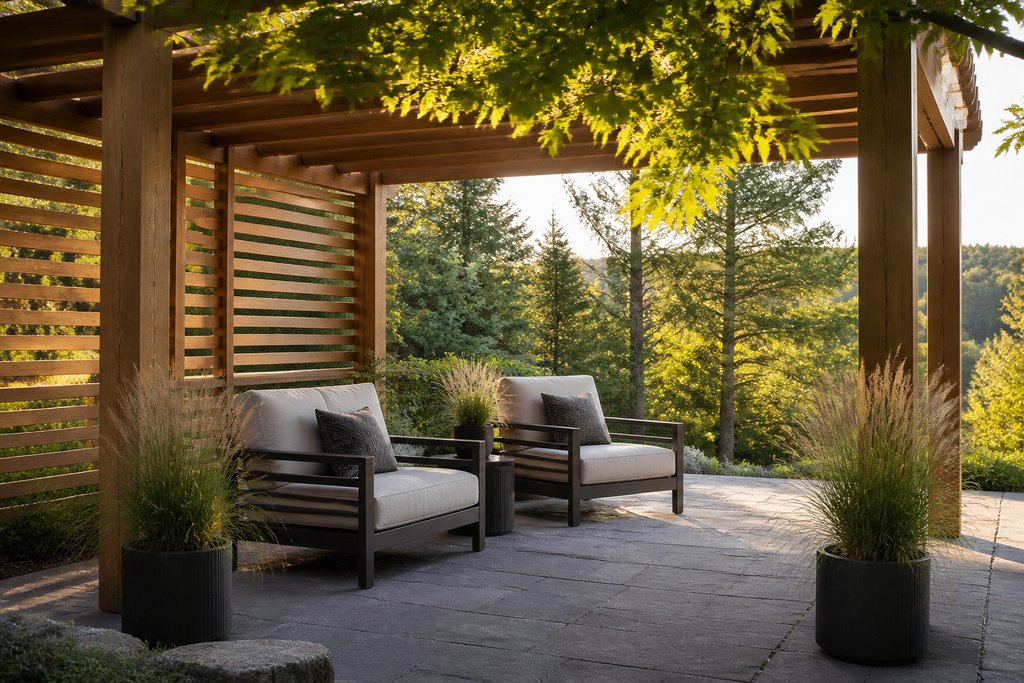
Achieving backyard seclusion on an established residential property requires thoughtful spatial planning. Effective landscape design in Orangeville combines layered evergreen and deciduous plantings, targeted architectural screens, and careful preservation of existing mature canopies. By shifting sightlines and framing functional micro-zones near the home, you can create a quiet, private sanctuary even on narrow footprints.
Layering Depth on Compact Town Lots
When neighbors sit just beyond a property fence, homeowners often default to planting a wall of cedar hedges. While understandable, that approach cuts off yard depth and can make a compact outdoor space feel like an enclosed green box. True outdoor intimacy comes from layering vertical textures and staggering heights.
Instead of lining the boundary with a single species, our Orangeville landscape design and construction work focuses on establishing foreground, midground, and background plant groupings. Low natural stone seat walls or raised beds create immediate visual interest near the back terrace. Behind them, flowing ornamental grasses and compact shrubs build mid-level separation, while taller screening elements finish the perimeter.
This tiered depth breaks the view into manageable pieces. Your eye settles on the rich texture of Wiarton flagstone, weathered granite steps, or gently waving grass plumes rather than the neighboring roofline.
Protecting and Designing Around Mature Trees
Many older neighborhoods across town enjoy the blessing of sixty-year-old maples, towering oaks, and mature spruce trees. These established canopies provide overhead screening that would take decades to grow from scratch. However, building stone patios or outdoor dining spaces around them demands precise site handling.
When executing a small backyard design Orangeville project, preserving the root zone of mature trees is essential. Cutting major structural roots to drop in a deep gravel sub-base can shock or kill a legacy tree within two seasons.
- Map the tree drip line before planning any permanent stone terraces or footings.
- Use permeable natural stone set on breathable crushed aggregate instead of poured concrete pads.
- Hand-dig post footings near key root zones to route around critical structural roots.
- Apply a thick layer of natural shredded bark mulch to preserve ground moisture during work.
Protecting mature root systems preserves natural beauty and saves thousands of dollars in tree removal costs down the line. We integrate these grand old canopies right into the comprehensive master plan, letting their shade naturally define quiet conversation nooks.
Strategic Screening with Proven Regional Plantings
Reliable privacy screening requires species that hold up to heavy winter snowfall, gusty winds, and variable spring conditions. While non-native privacy options often struggle through freeze-and-thaw cycles, resilient native and regionally adapted varieties thrive with minimal fuss.
The most convincing privacy screens feel like intentional woodland gardens rather than defensive boundary lines.
For tight boundary borders, mix sturdy evergreens with character-rich deciduous trees. Deciduous varieties drop their leaves in November, but their dense branch structures and summer foliage block neighborhood views during the exact months you spend outside.
| Screening Plant | Best Location | Key Benefit |
|---|---|---|
| **Eastern White Cedar** | Property borders and narrow side lots | Year-round dense greenery and tidy habit |
| **Serviceberry** | Near patios and terrace perimeters | Four-season beauty with delicate spring blooms |
| **Pagoda Dogwood** | Understory beneath mature shade trees | Horizontal branching that redirects the eye |
| **Karl Foerster Feather Reed Grass** | Along low walls and seating edges | Fast vertical height with winter silhouette interest |
Combining these selections produces a tapestry of living texture. For more seasonal planting strategies for your property, read our guide on fall landscape planning in Orangeville.
Built Elements: Pergolas, Stone, and Vertical Screens
Plants soften boundaries, but built structures give you immediate, dependable privacy on day one. When upper-floor windows from neighboring houses look straight down into your outdoor seating area, traditional fences simply cannot block the sightline.
This is where overhead carpentry excels. A tailored pergola or pavilion built from clear western red cedar creates a physical ceiling over your dining table or lounge chairs. Adding horizontal cedar louvers or slatted panels to one side lets gentle breezes drift across the patio while blocking direct sightlines.
Natural stone retaining elements also introduce distinct elevation changes that make a smaller yard feel expansive. Sinking a fire feature patio twelve inches below the surrounding lawn creates a cozy courtyard feel, naturally cutting off street-level sightlines.
Managing Soil, Slope, and Runoff
In-town properties present distinct grading and drainage puzzles. Decades of neighboring additions, repaved driveways, and sloped roof runoff frequently send stormwater into compact rear yards. Adding extensive stonework without an integrated drainage plan turns a private terrace into a seasonal wading pool.
Addressing these conditions requires an intentional grading strategy beneath the finish materials:
- Subsurface French drains collect roof gutter discharge and route it safely to dry wells.
- Open-graded aggregate bases (crushed stone without fine dust) allow storm runoff to filter into native soil without shifting your patio stones.
- Geogrid layers (a woven plastic mesh that locks gravel layers together) stabilize stone terraces built on gentle slopes.
When structural drainage is handled properly underground, surface stonework stays level through decades of southern Ontario frost cycles.
Moving from Initial Concept to Backyard Reality
Transforming an exposed backyard into a calm haven requires careful sequencing. Working within tight property lines means every step—from equipment access and utility locates to material delivery—must be calculated in advance.
Autumn is the ideal time to take site measurements, develop construction drawings, and line up municipal approvals. By establishing your design layout during the quiet fall months, site excavation and planting can start the moment soil warms in spring. If you are ready to explore the possibilities for your property, get in touch with our team to arrange a design consultation.
Frequently asked
Questions, answered
- How can I block the view from my neighbor's second-storey window?
- A standard property fence cannot block upper-storey angles, so overhead carpentry like a western red cedar pergola combined with small ornamental trees like serviceberry or pagoda dogwood creates an overhead canopy directly above your patio.
- Will heavy stone construction hurt the mature trees in an established Orangeville yard?
- Not when planned carefully. We locate structural tree roots before excavating, use permeable crushed aggregate bases that let oxygen reach tree roots, and hand-dig structural footings around major root zones.
- What privacy screening plants survive best in southern Ontario winters?
- Eastern white cedar, emerald cedar, serviceberry, and dense upright ornamental grasses like feather reed grass all handle regional freeze-thaw cycles reliably.
- Do I need a town permit to install a custom privacy screen or pergola?
- Pergolas and open shade structures under specific square-footage limits generally do not require building permits in town, though boundary fence heights and property line setbacks must strictly follow local zoning bylaws.
Related on the site
Start a conversation
Planning a project in the Headwaters region?
We design and build across Hockley Valley, Caledon, Mulmur, Mono, King, and The Blue Mountains. Tell us about your property and we'll take it from there.
Book a discovery call →