
stonework
Using Natural Stone Veneer to Unify Your Outdoor Structures
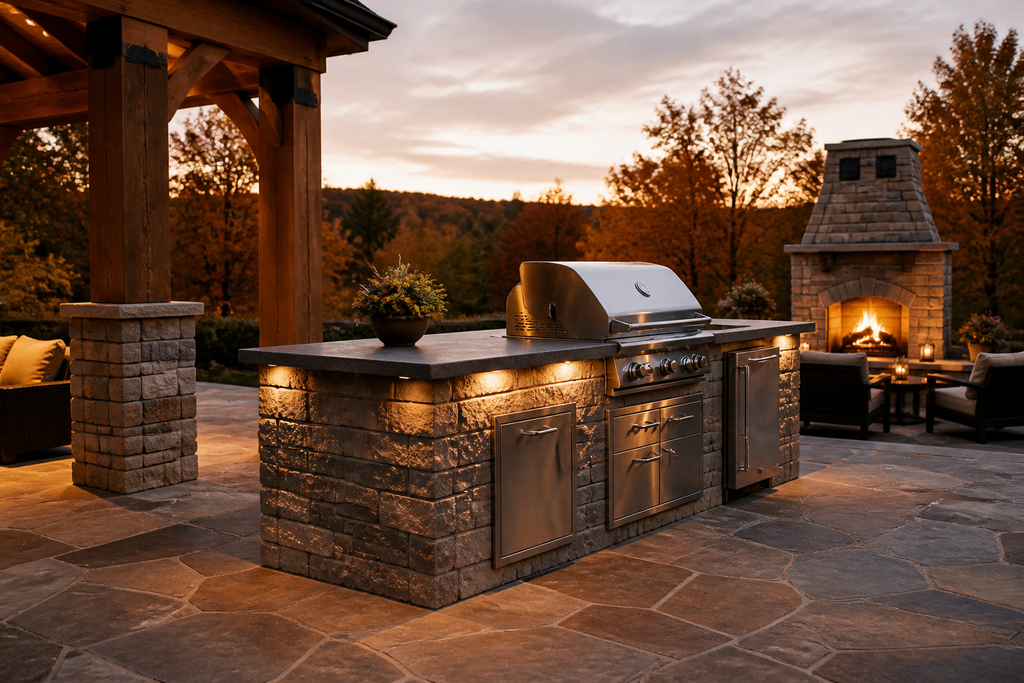
Natural stone veneer is an architectural cladding—a thin, real stone layer applied over concrete block—that unifies your landscape's vertical elements. From outdoor kitchen islands to pergola pillars and fireplaces, matching this veneer to your flatwork creates a cohesive, estate-quality finish for properties across the Headwaters region.
The Role of Veneer in Landscape Architecture
When you look at a massive stone fireplace on a terrace, you are rarely looking at solid, stacked boulders. You are looking at a concrete block core wrapped in natural stone veneer.
Veneer is simply real stone that has been sawn thin, usually one to two inches thick. It gives you the exact texture, color, and permanence of full-bed masonry, but at a fraction of the weight.
This structural efficiency is what allows us to clad everything from a simple grill island to towering pavilion walls. Because the stone is lighter, we can build substantial-looking architectural features without requiring massive, bridge-grade concrete footings underneath every single wall.
By using veneer, we also gain incredible design flexibility. We can wrap curves, clad structural steel, and seamlessly blend the landscape's built elements with the exterior of your custom home.
Designing a Cohesive Outdoor Kitchen
The outdoor kitchen is often the hub of summer entertaining. Because it sits directly on your main dining terrace, the materials you choose must speak to the ground beneath them.
Using natural stone veneer for outdoor kitchen cabinetry turns a functional grill station into a permanent architectural feature. It grounds the appliances, making the kitchen look like it was built into the landscape rather than just placed on top of it.
Unlike stucco or manufactured faux-stone, real stone handles the freeze-thaw cycles of an Ontario winter effortlessly. It also shrugs off the intense heat generated by built-in gas grills, smokers, and pizza ovens.
| Material | Durability | Aesthetic |
|---|---|---|
| Natural Stone Veneer | Excellent freeze-thaw resistance. Will not fade. | Authentic texture, unique veining, natural color variation. |
| Manufactured Stone | Prone to fading over time. Can chip to reveal concrete core. | Repeating patterns, artificial coloring. |
| Stucco / Plaster | Requires regular maintenance. Vulnerable to impact and moisture. | Clean, modern, but lacks the organic warmth of stone. |
Anchoring the Space with an Outdoor Fireplace
A custom fireplace draws the eye upward, serving as the visual anchor of your outdoor living room. It provides warmth on crisp autumn evenings and acts as a stunning focal point year-round.
Selecting the right outdoor fireplace stone veneer is about balancing scale. A towering chimney needs a stone profile with enough visual weight to look structurally sound, even though the veneer itself is relatively light.
We often use larger, roughly squared stones for fireplaces to give the structure a sense of historic permanence. The goal is to make the new structure feel like it has always been there.
A well-designed outdoor fireplace should look as though it was built a century ago, rising naturally from the patio beneath it.
Grounding Shade Structures with Stone Pillars
Wood structures like pavilions and pergolas need a visual transition before they meet the patio. Without it, heavy timber posts can look spindly or disconnected from the landscape.
Wrapping the base of your timber posts creates stone pillars for pergola or pavilion supports. This grounds the structure, giving it a substantial, estate-quality presence that matches the rest of your hardscape.
It also serves a highly practical purpose. The stone base keeps the bottom of the wood posts elevated above the splash zone of the patio, protecting the timber from moisture rot and winter snow buildup.
When we build an all-season structure, these stone pillars often house electrical conduit for integrated lighting, hiding the wiring while illuminating the stonework at night.
Integrating Veneer with Water Features and Pools
When designing a pool surround, the vertical surfaces are just as important as the paving. The materials you choose for the pool area should echo the materials used near the house.
A raised spa, a sheer descent water feature, or a low seating wall around the pool deck all require cladding. Applying the same stone veneer to these pool features ties the entire backyard together.
This creates a visual bridge between the active pool zone and the dining spaces. When the outdoor kitchen, the fireplace, and the water feature all share the same stone profile, the property feels intentionally designed and perfectly balanced.
The Art of Matching Stone Veneer to Your Patio
The secret to a landscape that feels calm and unified is a restrained material palette. Matching stone veneer to patio paving is the most effective way to achieve this cohesion.
If your terrace is built with large, square-cut Wiarton limestone flagstone, introducing a completely different stone for your walls creates visual clutter. The eye doesn't know where to rest.
Instead, we frequently use a Wiarton stone veneer. Because both the patio and the walls are cut from the exact same geological source, the colors and textures naturally harmonize, even if the cut style is slightly different.
- Source from the same quarry: Ask your designer to specify veneer and flagstone from the same geological region.
- Play with texture: Pair a smooth, sawn-finish patio with a rough, split-face veneer in the same stone type for subtle contrast.
- Coordinate the caps: Use the same stone for your wall coping (the flat stone on top of the wall) as you use for your patio paving.
- Consider the mortar: The color of the mortar joint drastically changes the look of the veneer. Test a few shades before committing.
Planning Your Stonework This Fall
Fall is the season for design and material selection. Sourcing premium natural stone takes time, especially for custom cuts, specific color blends, and large-scale retaining walls.
By finalizing your masonry choices now, you secure your materials over the winter. When the ground thaws in the spring, your project is ready to break ground immediately, rather than waiting in a queue at the quarry.
Whether you are planning a simple grill island or a comprehensive outdoor entertaining space across Caledon, King Township, or the Blue Mountains, unifying your structures with natural stone is an investment in permanence. If you are ready to begin planning your spring landscape, we invite you to start a project with our design team today.
Frequently asked
Questions, answered
- Can natural stone veneer be applied over an existing concrete wall?
- Yes, provided the existing concrete is structurally sound and free of deep cracks. We typically apply a metal lath (a wire mesh) and a scratch coat of mortar to give the new stone a secure surface to bond with.
- Does stone veneer require a concrete footing?
- While the veneer itself is relatively light, the concrete block core it attaches to requires a proper footing. In Ontario, this means digging down below the frost line (typically four feet) to prevent winter heaving and structural cracking.
- How do you clean an outdoor stone kitchen island?
- Real stone is incredibly low-maintenance. For a grill island, a simple wash with mild dish soap and a soft-bristle brush will remove most grease or food spills. Avoid harsh chemical cleaners that can etch the natural stone.
- Can we match the veneer on our patio to the stone on our custom home?
- Absolutely. We frequently work with builders and architects to source stone from the exact same quarry used for your home's exterior, ensuring the landscape feels like a seamless extension of the house.
- How long does the masonry phase of a landscape project take?
- Timelines vary based on the scale of the design, but custom stonework is a meticulous process. Cladding an outdoor kitchen, fireplace, and pergola pillars typically takes our masons several weeks of focused work.
Related on the site
Start a conversation
Planning a project in the Headwaters region?
We design and build across Hockley Valley, Caledon, Mulmur, Mono, King, and The Blue Mountains. Tell us about your property and we'll take it from there.
Book a discovery call →