
stonework
The Art of the Approach: Designing a Natural Stone Walkway
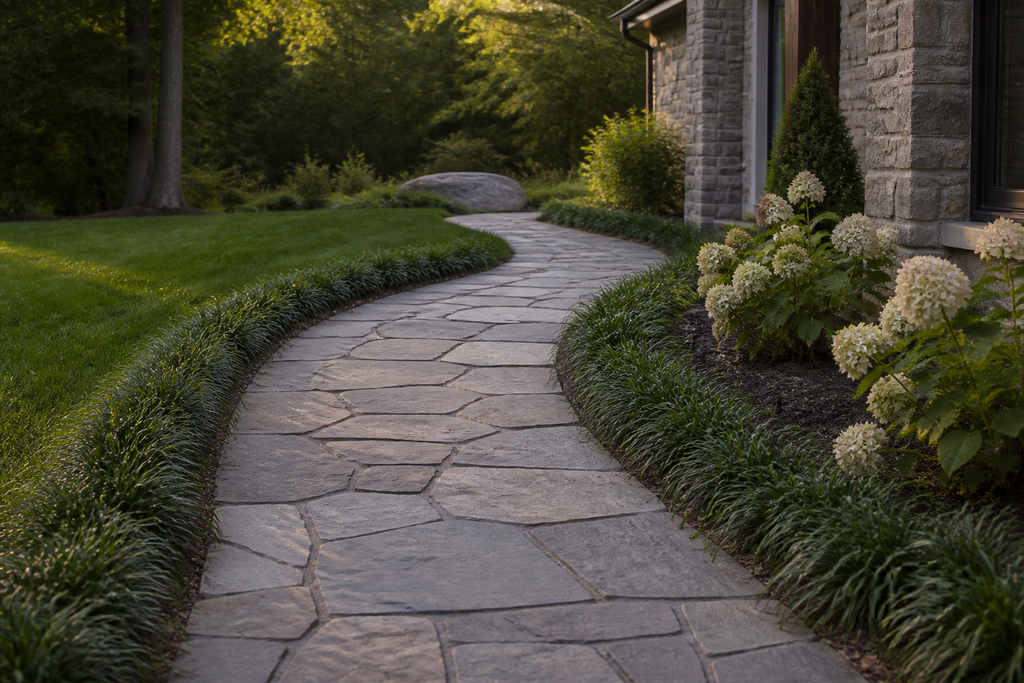
Effective natural stone walkway design considers the path's purpose, the home's architecture, and the surrounding landscape. Key factors include choosing the right stone, like flagstone or limestone, determining a generous width for comfort, and deciding between a formal straight path or an organic, curved layout that complements the land.
First, Where is the Path Leading?
The first question we ask isn't about stone—it's about purpose. A grand walkway to your front door has a very different job than a meandering path through a back garden. The function of the path dictates its form, width, and character.
A primary entrance walkway is about welcome and clarity. It should feel generous and intuitive, guiding visitors from the driveway to the door without a moment's confusion. It needs to be wide enough for arriving guests with luggage or for two people to walk together under an umbrella. This is a path of presentation.
A secondary garden path, on the other hand, is about discovery. It can be narrower, more rustic, and less direct. Its purpose is to invite you into the landscape, to lead you to a quiet bench, a vegetable garden, or a hidden water feature. It slows you down and encourages you to look around.
- Front Walkway: Direct, wide (4-5 ft+), clear destination, formal or semi-formal materials.
- Garden Path: Meandering, narrower (2-3 ft), encourages exploration, can use more rustic materials like stepping stones.
- Utility Path: Purely functional, connecting a side door to a shed or garage, focused on durability and directness.
Choosing Your Stone: Texture, Colour, and Scale
The choice of stone is the most personal part of natural stone walkway design. It’s a decision about texture underfoot and the colour you see from the kitchen window. We work almost exclusively with real stone because it has a character that manufactured products can't replicate. It has history, permanence, and a connection to the local geology.
Our masons create paths from a palette of beautiful, durable materials appropriate for the Ontario climate:
- Wiarton or Eramosa Flagstone: This is a classic Southern Ontario stone, a dolomitic limestone known for its warm buff, grey, and brown tones. Its surface often reveals beautiful fossil patterns, giving each piece a unique identity. It feels solid and timeless.
- Credit Valley Sandstone: Sourced from our region, this stone offers a richer, warmer palette of reds, browns, and oranges. It brings a distinct warmth and is often used for heritage-style properties.
- Granite: For ultimate durability, especially for steps or inlaid details, granite is unmatched. We often use it with a flamed finish, a process that uses high heat to pop crystals at the surface, creating a beautiful, non-slip texture.
- Weathered Limestone: For steps, curbs, or retaining edges along a path, we often use large, weathered limestone pieces. Their soft grey colour and naturally worn texture make them look as if they've been part of the landscape for a very long time.
| Natural Stone | Concrete Pavers |
|---|---|
| Each piece is unique in colour, texture, and shape. Ages gracefully, developing a rich patina. | Uniform in size, colour, and texture. Can fade or show wear patterns over time. |
| Higher upfront material cost, but offers exceptional longevity. | Lower material cost, but may need replacing sooner. Style can become dated. |
| Irregular shapes require skilled stonemasons to fit, creating an artisanal, handcrafted look. | Interlocking patterns are installed more quickly. Can sometimes look mechanical or repetitive. |
The Shape of the Walkway: Straight Lines vs. Gentle Curves
A straight path is the shortest distance between two points. It feels formal, intentional, and strong. It works beautifully with modern or classical architecture, creating clean sightlines and a sense of order. A straight, wide walkway bordered by formal plantings makes a powerful statement.
A path shouldn't just get you there; it should change how you feel on the way.
A curved stone walkway, however, creates a different feeling entirely. It’s more organic and gentle. A soft curve slows the pace, forcing a more leisurely stroll. It can be used strategically to guide the eye, revealing a beautiful view or a specimen tree as you round a bend. On a country property, a curved path feels more at home, echoing the natural roll of the land.
The Unseen Foundation: Why the Base Is Everything
In Ontario, a beautiful stone walkway can be ruined in a single winter if it's not built correctly. The secret to a path that remains flat and stable for many years is the deep, robust foundation beneath the stones. Frost heave—the upward swelling of soil during freezing conditions—is a powerful force that can lift and shift improperly set stones.
Our approach to building a permanent walkway is uncompromising. The process involves several critical steps:
- Excavation: We dig down well below the local frost line, often 12 inches or more, removing all topsoil and organic matter.
- Geotextile Layer: A heavy-duty fabric is laid down to separate the gravel base from the soil below, preventing them from mixing over time.
- Compacted Aggregate Base: We add a deep layer of ¾” clear gravel, compacting it in lifts to create a solid, interlocking, and free-draining foundation.
- Setting Bed: A final, thinner layer of finer material, like limestone screenings, is used to precisely set each stone to the perfect height and slope for drainage.
For paths on slopes or in areas with less stable soil, we often add geogrid—a strong plastic mesh—within the gravel layers to lock them together and provide exceptional structural stability.
Integrating the Walkway with Plantings and Lighting
A walkway is only one element of a successful landscape. To make it feel truly integrated, it needs to be thoughtfully combined with plantings and lighting. The goal is to soften the stone edges and create a journey that delights the senses day and night.
Thoughtful planting turns a simple path into a garden experience. We select plants that complement the scale and style of the walkway.
- Soften the Edges: Low, mounding plants like **Japanese Forest Grass (Hakonechloa)** or **Lady's Mantle (Alchemilla mollis)** can spill gently over the stone, breaking up hard lines.
- Create Rhythm: Repeating upright plants like **Feather Reed Grass (Calamagrostis 'Karl Foerster')** along a path creates a pleasing rhythm and sense of movement.
- Engage the Senses: Planting fragrant herbs like creeping thyme in the joints of rustic paths releases a scent when walked upon.
- Consider All Seasons: We choose plants that offer interest year-round, from spring bulbs to summer flowers, autumn colour, and winter structure.
Subtle landscape lighting ensures the path is safe and beautiful after dark. We avoid the “runway” look of evenly spaced lights. Instead, we use low-voltage fixtures to cast soft pools of light on the walking surface, highlight changes in elevation like steps, and draw attention to a beautiful nearby tree or architectural feature.
The right lighting makes the walkway feel just as welcoming at 9 PM as it does at 9 AM.
Creating a truly exceptional natural stone walkway is a blend of artistry and engineering. It's about understanding how people move, how materials age, and how a property meets the land. When done right, it's an investment that adds lasting beauty and function to your home. If you're ready to plan the approach to your property, get in touch with our design team.
Frequently asked
Questions, answered
- How wide should a natural stone front walkway be?
- For a primary entrance, we recommend a minimum width of four to five feet. This allows two people to walk side-by-side comfortably and creates a generous, welcoming feeling appropriate for an estate property.
- Is a flagstone walkway slippery in the winter?
- Any surface can become slippery with ice. However, we select stone with a natural, cleft texture for better grip, and ensure the walkway has proper slope and a free-draining base to prevent water from pooling and freezing.
- How long does it take to build a stone walkway?
- The timeline varies with the length, complexity, and site conditions. A typical front walkway installation by our stonemasons can take from several days to a couple of weeks, following the completion of the landscape design and material sourcing.
- Do I need a permit for a walkway in Ontario?
- Generally, a simple on-grade walkway does not require a permit. However, if it is connected to structural elements like retaining walls over a certain height or involves significant grading changes, a permit may be necessary. Our team manages this process as part of the project.
- What is better for walkway joints, polymeric sand or stone dust?
- It depends on the style. For tight, clean joints in a formal flagstone path, polymeric sand is excellent as it hardens to resist weeds and erosion. For wider, more rustic joints, we often use fine stone dust or screenings, which can even be planted with creeping thyme for a soft, living look.
Related on the site
Start a conversation
Planning a project in the Headwaters region?
We design and build across Hockley Valley, Caledon, Mulmur, Mono, King, and The Blue Mountains. Tell us about your property and we'll take it from there.
Book a discovery call →