
stonework
Planting a Living Retaining Wall: A Guide for Ontario Landscapes
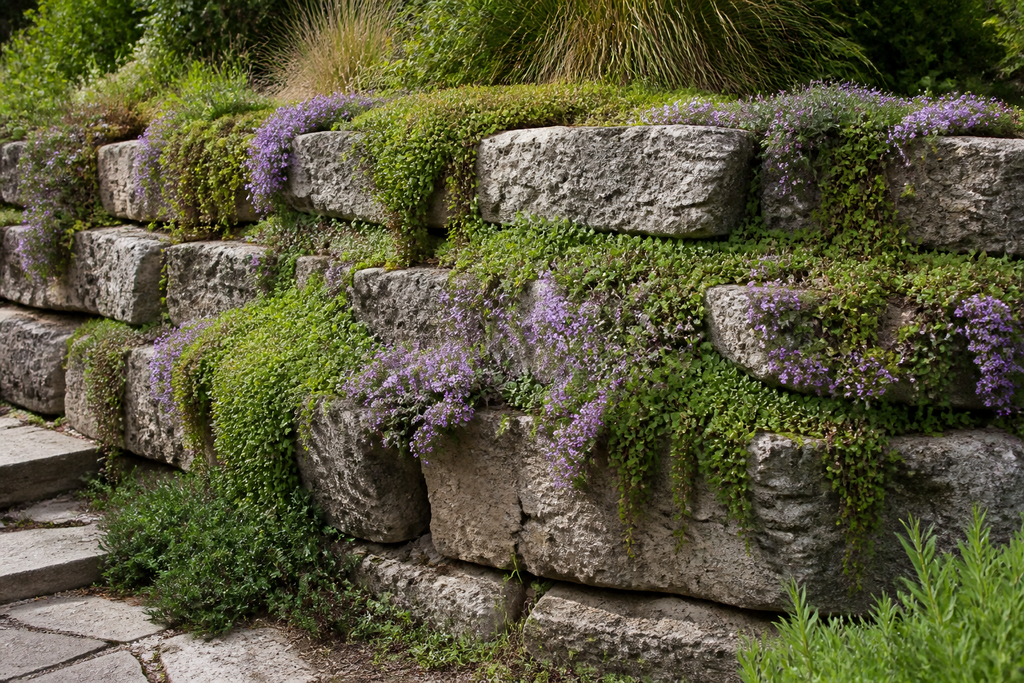
A natural stone wall is more than just a way to manage a slope; it’s a feature. But when plants begin to spill over its edges and tuck into its crevices, it becomes a garden. The right plants for retaining walls in Ontario transform a functional structure into a living, breathing part of your landscape, softening the hard lines and connecting it to the earth.
Why Plant in a Retaining Wall?
Imagine walking out to your terrace on a summer morning. The sun is warming the natural stone underfoot, and the scent of creeping thyme rises from the stone wall bordering the patio. Instead of a stark vertical face of stone, you see a tapestry of greens, silvers, and purples, with bees buzzing around flowering rock cress. This is the goal: to make the structure feel like it grew there.
Planting in and around your stonework does more than just look beautiful. It also:
- Softens Hard Lines: Plants break up the monolithic face of a wall, integrating it seamlessly into the surrounding gardens.
- Creates a Micro-Ecosystem: The cool, shaded crevices and sun-baked top edges provide unique microclimates for a diverse range of plants that might not thrive elsewhere on your property.
- Adds Four-Season Interest: From spring flowers to summer foliage, rich fall colour, and evergreen textures dusted with snow, a planted wall is always changing.
- Reduces Runoff: Plant roots help to absorb and slow rainwater as it moves down the face of a wall, a small but meaningful act of stewardship.
Choosing the Right Plants for Ontario Walls
The environment of a stone wall is demanding. It’s often dry, exposed to wind, and has limited soil. The best plants are tough, resilient, and naturally suited to rocky, alpine conditions. For our projects in southern Ontario, we focus on species that thrive in a Zone 5b climate.
We group them into three categories:
- The Spillers (Cascaders): These are the stars of the show, trailing down the wall face to create that lush, cascading effect.
- The Fillers (Crevice Dwellers): These compact plants are perfect for tucking into the small gaps and joints of a wall.
- The Accents (Uprights): Taller, more structural plants placed at the top or base of the wall to provide contrast and height.
Here are a few of our go-to choices for southern Ontario:
- Creeping Thyme (Thymus serpyllum): A tough, sun-loving groundcover that releases a wonderful scent when brushed against. It forms a dense mat and produces tiny pink or purple flowers.
- Rock Cress (Aubrieta deltoidea): In spring, this plant explodes into a curtain of vibrant purple, pink, or blue flowers. It’s a classic choice for a spectacular seasonal display.
- Sedum (Stonecrop): Many varieties excel in walls. 'Angelina' sedum offers chartreuse foliage that turns orange in the fall, while others hug the stone with tight, mat-forming leaves.
- Hens and Chicks (Sempervivum): These rosette-forming succulents are perfect for tucking into small, sunny crevices where almost nothing else will grow. They are incredibly drought-tolerant.
- Armeria (Sea Thrift): This plant sends up charming globe-like pink or white flowers on slender stems from a tidy clump of grass-like foliage.
- Campanula (Bellflower): Certain trailing varieties, like Campanula portenschlagiana, are fantastic for cascading over walls in sun or part-shade, offering a profusion of purple, bell-shaped flowers.
The Technique: How We Plant in Stone Walls
Successfully establishing plants in a stone wall isn’t as simple as stuffing a plant into a crack. It requires foresight during construction and a specific technique for planting.
For new walls, especially a dry-stone wall, we build planting pockets directly into the structure. These are intentional voids behind the face stones, connected to the backfill and filled with a specialized soil mix. This gives the roots a place to anchor and find moisture.
For existing walls, we use a technique called “mud-packing.”
- We mix our custom soil blend with water to create a thick, clay-like slurry.
- We carefully work a small plant plug (a young plant with a small root ball) into a suitable crevice.
- We then pack the mud slurry in and around the roots, ensuring good contact with the stone and eliminating air pockets. The slurry holds the plant in place and retains moisture while it establishes.
A stone wall gives a property its bones; the plants give it a soul.
Irrigation and Long-Term Care
A stone wall, particularly a south-facing one, is a hot, dry place. While we select drought-tolerant plants, they still need consistent water to get established. The best way to provide this is with drip irrigation.
We typically run a line of drip tubing along the top of the wall, hidden behind the capstones, with emitters positioned to water the pockets from above. In some cases, a second line can be run along the base. This targeted approach is far more effective than spraying the wall with a hose, which wastes water and can dislodge new plantings.
Once the plants are established, their water needs decrease significantly. The establishment period is the most critical for consistent establishment care, especially during hot spells.
Integrating Planted Walls into a Master Plan
A planted retaining wall should never be an afterthought. In a comprehensive landscape design, it’s a key element that connects different areas of the property. It can be the feature that makes a sunken fire pit area feel intimate, or the graceful transition between the main terrace and the pool deck below.
When we design a property with significant grade changes, we see retaining walls as opportunities. We think about the view from the kitchen window in autumn and choose plants like 'Angelina' sedum for its fiery fall colour. We consider the path to the front door and use fragrant creeping thyme to create a sensory experience.
The wall becomes part of the garden, not just a border for it. By planning for plants from the very beginning, we create a landscape that feels cohesive, mature, and deeply connected to its place. If you're considering how to manage a slope on your property, let's talk about how a living wall can be part of the solution.
You can get in touch with our design team to start the conversation.
Frequently asked
Questions, answered
- What is the best time of year to plant a retaining wall in Ontario?
- Spring is the ideal time, as it gives plants the entire growing season to establish their roots. Early fall is also a good window, allowing roots to grow before the ground freezes.
- Can I add plants to my existing mortared stone wall?
- It's more challenging than with a dry-stone wall, but not impossible. We look for larger planting beds at the top or base of the wall and choose aggressive cascadings species that can root in the soil and spill over the stone face.
- Do planted walls require special soil?
- Yes, absolutely. We use a custom gritty, free-draining mix, often using limestone screenings and sand, which mimics the natural alpine conditions these plants love. Standard garden soil holds too much water and can lead to rot.
- How are the plants in a tall retaining wall watered?
- For any significant planted wall, we install dedicated drip irrigation. The lines are hidden at the top of the wall behind the capstone, delivering water directly to the root zones with minimal waste.
- What plants provide winter interest in a stone wall?
- We rely on evergreen perennials like certain Sedums, Hens and Chicks (Sempervivum), and Candytuft (Iberis). Small ornamental grasses and the structure of dormant woody plants also add texture against the snow.
Related on the site
Start a conversation
Planning a project in the Headwaters region?
We design and build across Hockley Valley, Caledon, Mulmur, Mono, King, and The Blue Mountains. Tell us about your property and we'll take it from there.
Book a discovery call →